
Portable Card Machines: Shop Floor Selling Guide 2026
- Content Team
- 2 hours ago
- 12 min read
Why are you still forcing your customers to stand in a queue when the sale is already won? In a retail environment where almost 95% of in-store transactions are now contactless, the traditional fixed till is fast becoming a bottleneck rather than a service point. Most shop owners recognise the frustration of losing a sale simply because the checkout line looked too daunting. Finding the right portable card machine for retail is no longer a luxury; it's a strategic necessity to keep your floor moving and your customers engaged.
We understand that reliability is your primary concern. You need hardware that won't drop its connection during a Saturday rush and a system that puts your hard-earned money into your account without delay. This guide explores how to decentralise your point of sale using professional-grade tools like the Dojo Go and the smartphone-sized Dojo Pocket. You'll learn how to achieve faster customer turnover, maintain seamless connectivity across your entire shop, and secure next-day access to your takings to keep your cash flow healthy. We will also cover the latest PCI DSS v4.0.1 standards to ensure your business remains secure and compliant in 2026.
Table of Contents
Beyond the Counter: Why Retailers are Switching to Portable Payments
Connectivity and Reliability: The Tech Behind Retail-Grade Portable Machines
Comparing Portable, Mobile, and Countertop Terminals for Your Shop
Queue-Busting and Beyond: How to Organise Your Retail Floor for Maximum Sales
Selecting the Right Partner: Why Speed and Security Matter for Modern Retail
Beyond the Counter: Why Retailers are Switching to Portable Payments
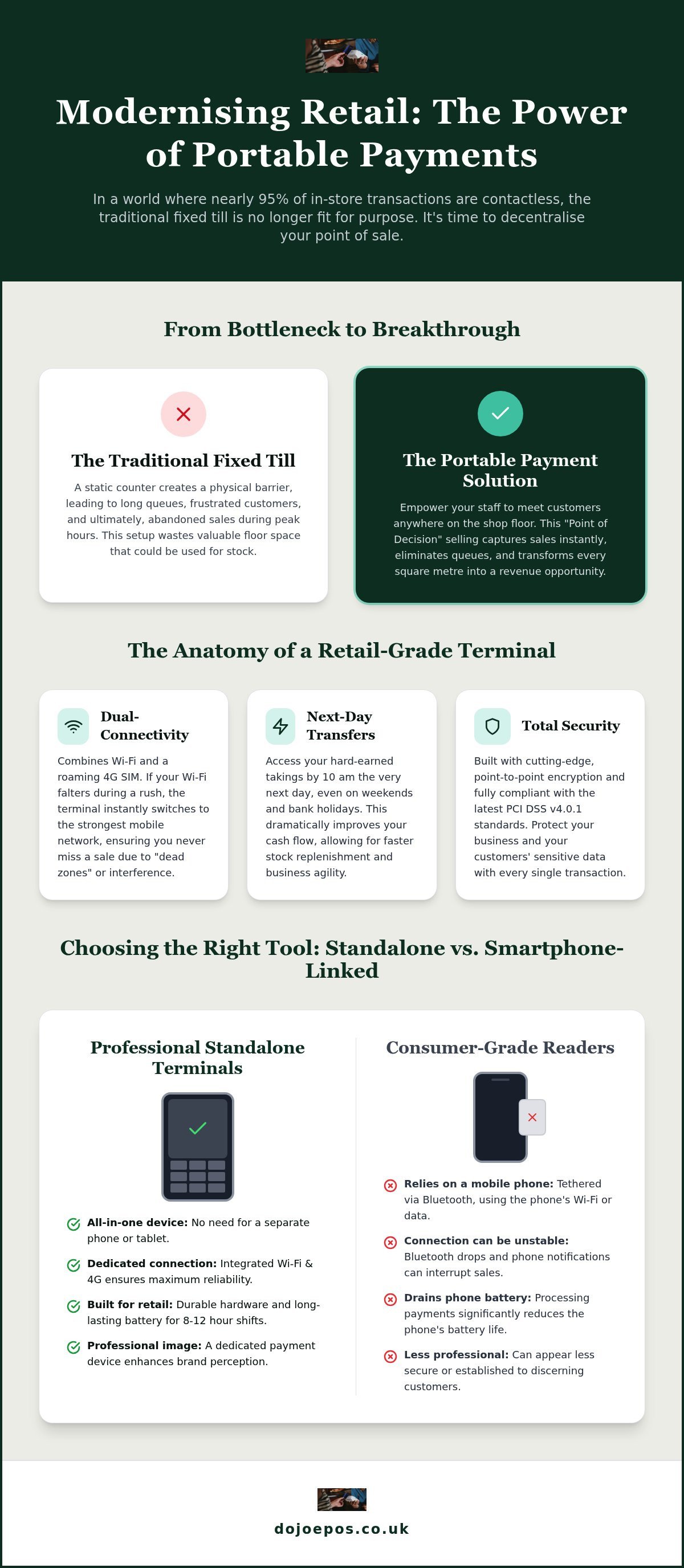
Retail is evolving at a breakneck pace. The days of a customer wandering through your store only to be met by a physical bottleneck at the checkout are over. A portable card machine for retail is a standalone, wireless device designed to mirror the full merchant capabilities of a traditional till, but with the total freedom of the shop floor. It isn't just a piece of hardware. It's a strategic shift towards decentralising your point of sale. By meeting customers exactly where they stand, you capture interest at the peak of their intent, turning casual browsers into confirmed buyers before they have a chance to reconsider.
The Evolution of the Retail Checkout
Retail history is marked by the steady decline of the tethered counter. To understand what a payment terminal is in 2026, you must look at its transition from heavy, analog cash registers to sleek, cloud-connected devices. Modern shop floor design now prioritises movement and flow over fixed service stations. The traditional "centre-of-shop" till often creates a physical barrier that disrupts the customer journey. By contrast, technology like the Dojo Go allows your team to facilitate transactions amongst the aisles, turning every square metre of your premises into a potential revenue generator.
Core Benefits for Modern UK Merchants
The advantages of adopting a mobile-first approach extend far beyond simple convenience. For the modern UK merchant, this flexibility is about reclaiming control over the retail environment and the bottom line.
Optimised Floor Space: Removing bulky till points allows you to display more stock or create a more inviting, open environment.
Active Queue-Busting: A reliable portable card machine for retail allows staff to intercept queues before they form. This proactive approach keeps customers happy and prevents abandoned sales during peak periods.
Total Security: Modern portable units offer cutting-edge encryption and point-to-point security, protecting your business and your customers' data.
Consumer behaviour has shifted. Customers now expect the same speed and convenience in-store that they find online. They've grown accustomed to the ease of digital wallets, which now dominate the payment landscape. Providing a roving service caters to this demand for immediacy whilst positioning your brand as a professional, forward-thinking leader. When you combine this on-floor agility with next-day transfers, your business gains the financial momentum needed to replenish stock and react to market trends without delay.
Connectivity and Reliability: The Tech Behind Retail-Grade Portable Machines
Peak trading hours are the ultimate test for any shop floor. When the queue builds and every second counts, a dropped connection isn't just an inconvenience; it's a direct threat to your revenue and brand reputation. Professional retail environments demand more than basic hardware. A high-quality portable card machine for retail must provide consistent, unbreakable uptime to ensure you never miss a transaction. Resilience starts with the internal architecture of the device, specifically how it manages its link to the outside world.
Wi-Fi vs 4G: Why You Need Both
Dual-connectivity is the gold standard for modern retail. Whilst shop Wi-Fi is generally fast, it's prone to interference from other devices or physical barriers. Large retail units and older buildings with thick stone walls often suffer from signal "dead zones" where standard Wi-Fi simply cannot reach. This is where merchant-grade technology proves its worth.
Devices like the Dojo Go utilise 4G roaming SIMs that act as an essential failover. If your Wi-Fi falters, the machine switches instantly to the strongest available mobile network without interrupting the sale. Unlike consumer-grade Bluetooth readers that rely on a tethered smartphone, standalone portable terminals maintain their own dedicated connection. This independence ensures that even in the furthest corners of your store, the payment process remains fluid and secure.
Hardware Durability and Battery Performance
Retail-ready build quality is non-negotiable. Your hardware will face constant handling, occasional drops, and the frantic pace of an 8 to 12-hour shift. Professional devices are engineered to resist these daily rigours whilst maintaining a sleek, premium aesthetic that reassures your customers.
Battery Longevity: Look for high mAh (milliampere-hour) ratings that guarantee a full day of trading on a single charge.
Fast-Charging: When the battery does run low, rapid-charging docks ensure your terminal is back on the floor within minutes, not hours.
Processing Speed: Rapid internal processors reduce the "spinning wheel" wait time, keeping your transaction flow brisk and professional.
Reliability also extends to how quickly you can access your funds. Technical excellence on the shop floor should be matched by back-end efficiency. Choosing high-performance payment hardware that integrates with your POS system allows for real-time sales tracking and next-day transfers. This ensures your cash flow remains as agile as your floor staff, allowing for rapid stock replenishment and business growth. In the fast-moving retail market of 2026, staying connected means staying profitable.
Comparing Portable, Mobile, and Countertop Terminals for Your Shop
Hardware choice defines your customer's final impression of your brand. While some retailers thrive with a fixed point of sale, others require the agility of a portable card machine for retail to maintain momentum. The decision hinges on whether your staff act as static cashiers or active sales consultants who guide the customer through the store. Matching your hardware to your specific operational flow ensures you don't just take payments, but actually enhance the shopping experience.
It is vital to distinguish between "mobile" readers and "portable" terminals. Mobile readers typically connect to a smartphone or tablet via Bluetooth. While these are useful for micro-merchants, they can feel unprofessional in a high-end retail setting and rely heavily on a second device's battery and connectivity. Standalone portable devices, such as the Dojo Go, offer the full functionality of a till in a handheld format. These professional-grade units feature large touchscreens and integrated thermal receipt printers, ensuring you don't compromise on the customer experience while moving across the floor.
When to Stick with Countertop Units
Fixed units remain the logical choice for high-volume, single-point checkouts where the terminal never needs to leave its power source. Small newsagents or kiosks often prefer this stability. In these settings, a constant power supply and a fixed location provide a reliable anchor for rapid-fire transactions. If your retail layout naturally funnels every customer to a single exit point, a countertop unit provides a permanent, high-speed solution that staff can operate with maximum efficiency.
The Case for Standalone Portability
Standalone devices come into their own in boutiques, showrooms, or multi-level shops. In these environments, staff often travel with the customer, providing personal advice amongst the aisles. Using a portable card machine for retail allows for "point of decision" selling, where payment is taken the moment the customer chooses an item. This is also the ideal solution for pop-up events or seasonal garden centres where fixed infrastructure is unavailable. For retailers with multiple floors, hardware like the Dojo Pocket allows staff to move effortlessly between levels without losing their connection.
Regardless of the hardware format, seamless integration with your EPOS system is essential. Systems like Blinq POS allow you to synchronise sales across all devices in real time. This ensures your inventory levels remain accurate whether the sale happened at the counter or in the changing room. This unified approach provides the professional oversight needed to manage a growing retail business with total confidence.
Queue-Busting and Beyond: How to Organise Your Retail Floor for Maximum Sales
The most critical moment in any retail journey is the "Point of Decision." This is the exact second a customer decides they want an item. In a traditional setup, that enthusiasm can quickly evaporate during the walk to the back of the shop or whilst standing in a slow-moving line. By deploying a portable card machine for retail, you move the checkout to the customer. This friction-free transition from browsing to buying keeps the emotional connection to the product alive, significantly reducing the risk of "buyer's remorse" or abandoned baskets.
Tactical Queue-Busting Procedures
Peak trading periods like Christmas or Bank Holidays require a dynamic approach to floor management. You should identify your "tipping point" early. This is the moment when a queue begins to obstruct aisles or discourage new shoppers from entering. A professional portable card machine for retail allows your team to intervene exactly when the wait time starts to impact the customer experience.
Equip roving staff with the Dojo Pocket to clear small transactions instantly.
Use Integrated Payments to ensure every sale is recorded in your Blinq POS system without manual entry.
Monitor stock levels in real-time whilst on the move to provide accurate advice to customers.
Train your team to transition from offering help to closing the sale smoothly. A simple phrase like "I can take payment for that right here for you" removes the final hurdle to purchase. This proactive behaviour prevents the shop floor from feeling congested and keeps the energy of the store high and focused on sales.
Creating a Personalised Shopping Experience
Portability allows you to offer a "VIP" service that was once reserved for high-end boutiques. Imagine allowing a customer to pay for their items directly from the dressing room or a private viewing area. This level of service increases the perceived value of your brand and makes the transaction feel like a curated experience rather than a chore. High-tech hardware like the Dojo Go reinforces this professional image, suggesting a business that is modern, secure, and efficient.
Beyond the sale, these devices are powerful tools for customer retention. You can collect customer data and send digital receipts via email directly from the terminal. This builds your marketing list whilst providing a modern convenience that shoppers appreciate. If you want to transform your shop floor into a high-conversion environment, you can upgrade your retail setup with Dojo to capture every sales opportunity. The psychological impact of a seamless checkout cannot be overstated. It builds trust and encourages repeat visits, turning one-time buyers into loyal brand advocates.
Selecting the Right Partner: Why Speed and Security Matter for Modern Retail
Choosing a portable card machine for retail shouldn't be a simple race to find the lowest transaction rate. Whilst a headline percentage might look attractive, it often hides the true cost of slow settlement, outdated hardware, and non-existent support. Modern retail requires a partner that understands the total cost of ownership. This includes the financial value of unbroken uptime and the speed at which your hard-earned takings reach your bank account. To thrive, you need a service that prioritises your business's momentum over basic technicalities.
Cash Flow: The Lifeblood of Retail
Waiting three to five working days for your funds is an outdated practice that can actively stifle your growth. In a retail environment, your cash needs to be as agile as your sales team. Next-day transfers ensure that your Saturday takings are available to you by Sunday morning, providing the liquidity needed for immediate stock replenishment or payroll management. This predictability transforms your financial planning. When you have next-day access to your funds as standard, you can react to market trends and inventory needs with total confidence.
Reliability and Support as a Safety Net
What is the actual cost of a terminal failure on a busy Saturday afternoon? It's the sum of every lost sale, every frustrated customer, and the long-term damage to your brand's reputation. Relying on a chatbot or an automated ticket system during a peak trading crisis is a risk no professional retailer should take. Access to 24/7 UK-based technical support means you're always one phone call away from a human expert who understands the urgency of your situation.
Operational efficiency is further enhanced through Integrated Payments. When your portable card machine for retail communicates directly with your Blinq POS system, you eliminate the need for manual data entry. This reduces human error, simplifies your end-of-day reconciliation, and allows your staff to focus entirely on the customer. This synergy between hardware and software is what separates a basic payment tool from a comprehensive retail management solution.
With over 110,000 businesses already served, Dojo Go and Dojo Pocket have established themselves as the ultimate retail-ready solutions. They provide the professional-grade performance and security required to lead the market in 2026. By partnering with a provider that balances high-tech innovation with human-centric support, you ensure your business is always ready to capture the next sale.
Future-Proof Your Retail Sales Strategy
Retail success in 2026 depends on your ability to meet customers at the point of decision. By decentralising your point of sale, you remove the physical and psychological barriers of the traditional checkout queue. This shift allows your staff to provide a premium, roving service that secures sales before interest fades. Integrating a professional portable card machine for retail ensures that your shop floor remains agile, connected, and entirely focused on the customer experience.
Choosing the right partner means prioritising the reliability of dual-connectivity and the speed of your settlement. With Red Dot award-winning hardware and 24/7 UK-based support, you can protect your business against downtime whilst maintaining a sleek, modern brand image. Most importantly, next-day transfers provide the liquidity you need to keep your inventory fresh and your operations moving forward.
Don't let outdated technology slow your growth. Switch to a Dojo portable card machine and get next-day transfers as standard. It's time to reclaim your floor space, empower your team, and build a retail environment that truly thrives.
Frequently Asked Questions
Do portable card machines for retail work without a Wi-Fi connection?
Yes, professional-grade portable card machines for retail are designed to function without a Wi-Fi connection by using integrated 4G roaming SIM cards. This dual-connectivity ensures that if your shop floor Wi-Fi signal drops or fails, the terminal automatically switches to a mobile network. This failover mechanism is essential for maintaining consistent service during peak hours, allowing your staff to process payments anywhere in the store or even at outdoor events without any interruption.
How long does the battery typically last on a portable retail terminal?
You can expect a professional portable terminal to last through a full 8 to 12-hour retail shift on a single charge. High-performance devices like the Dojo Go are engineered with high-capacity batteries to handle constant use without needing a mid-day top-up. For peace of mind, most systems come with fast-charging docks that can quickly restore power during brief lulls, ensuring your hardware is always ready for the next customer interaction on the shop floor.
Is a portable card machine as secure as a traditional countertop till?
Yes, portable machines utilise the same rigorous security protocols as traditional countertop units, including point-to-point encryption. As of 2026, all professional terminals must comply with the latest PCI DSS v4.0.1 standards, which focus on continuous security monitoring rather than annual checks. These devices don't store sensitive card data locally, meaning your business and your customers remain protected against fraud, regardless of where on the shop floor the transaction takes place.
Can I print receipts directly from a portable card reader?
Standalone portable terminals like the Dojo Go feature an integrated thermal printer, allowing you to hand over a physical receipt instantly. However, smaller devices like the Dojo Pocket often prioritise a sleek, smartphone-sized form factor and send digital receipts via email or SMS instead. Providing digital receipts is a modern convenience that many customers prefer, whilst also helping your retail business build a valuable marketing database for future engagement.
What is the difference between a mobile card reader and a portable card machine?
A mobile card reader is a small device that must be tethered to a smartphone or tablet via Bluetooth to process payments through an app. In contrast, a portable card machine for retail is a standalone unit with its own operating system, screen, and connectivity. Professional retailers usually prefer standalone portable terminals because they are more robust, operate independently of other devices, and typically offer faster processing speeds and integrated printing capabilities for a better customer experience.
How quickly can I access the money I take through my portable machine?
With the right payment partner, you can access your funds as soon as the next day. Standard practice in the industry used to involve waiting three to five working days, but modern providers like Dojo offer next-day transfers as a standard feature. This rapid settlement is a significant advantage for retail cash flow, allowing you to pay staff, manage payroll, and replenish stock without the frustration of waiting for your takings to clear.
Do I need a separate merchant account for a portable terminal?
No, you don't need to set up a separate merchant account specifically for a portable terminal. When you partner with a merchant services provider, they typically provide a unified account that covers all your payment hardware, whether it's countertop or portable. This integrated approach simplifies your financial management, as all your transactions are consolidated into a single dashboard, making it much easier to reconcile your daily sales and track overall business performance with total confidence.
Can portable card machines integrate with my existing retail POS software?
Yes, professional portable machines are designed to integrate seamlessly with modern POS systems. This connection, often called Integrated Payments, ensures that your card machine and your point-of-sale software communicate in real time. When you process a sale on the floor, the transaction details are automatically pushed to your software, such as Blinq POS. This eliminates the need for manual data entry, reduces human error, and keeps your inventory levels perfectly accurate across all sales channels.


Comments