
Handheld Card Machines: Faster Table Service in 2026
- Content Team
- 2 hours ago
- 12 min read
In 2026, the speed of your payment process is just as vital to your reputation as the quality of the food on your plates. You've likely felt the tension of a busy Saturday night when a clunky terminal fails or a WiFi dead zone creates an awkward queue at a table. Finding a high-performance handheld card machine for waiters isn't just a technical upgrade; it's a strategic move to protect your guest experience. You know that every second saved during the bill-paying process is a second your staff can spend on genuine hospitality rather than battling outdated hardware.
This article shows you how the right tools can revolutionise your restaurant service, increase table turnover, and empower your team to perform at their best. We'll explore the impact of ultra-portable designs that fit comfortably in an apron pocket and the operational benefits of seamless POS integration. By the end, you'll understand how to eliminate manual reconciliation errors and secure your cash flow with next-day transfers. It's time to trade heavy, unreliable devices for cutting-edge technology that keeps your business moving forward at pace.
Table of Contents
Why Handheld Card Machines are Essential for Modern Waiters
The days of guests queuing at a central till to settle their bill are fading fast. In British hospitality, the transition from fixed countertop units to flexible mobile solutions has redefined what service actually means. A modern handheld card machine for waiters is no longer just a portable version of a desk-bound device; it's a purpose-built tool designed to live in an apron pocket. While early wireless units were often heavy and cumbersome, today's technology focuses on sleek ergonomics and instant connectivity.
The "pay at the table" model is now the undisputed gold standard for UK restaurants and bars. Guests value the privacy and comfort of settling up without leaving their seats. For the business, this translates into faster table turnover and more accurate billing. When staff can process a payment terminal transaction instantly at the table side, they eliminate the dead time spent walking back and forth to a stationary hub. This efficiency doesn't just improve the bottom line; it directly boosts staff morale and increases the likelihood of better tips by removing friction from the final guest interaction.
The Shift from Countertop to Table-Side
The primary benefit of moving payments to the table is the reduction of physical distance. By bringing the bill directly to the guest, you remove the bottleneck of the "queue at the till" which often disrupts the flow of a dining room. It keeps the atmosphere professional and calm; ensuring that the last impression a customer has of your venue is one of attentive service rather than administrative delay. This seamless transition from dining to payment maintains the theatre of the restaurant, allowing waiters to close the guest journey with a personal touch whilst avoiding a trip to a cluttered bar counter.
Waiters as Efficiency Drivers
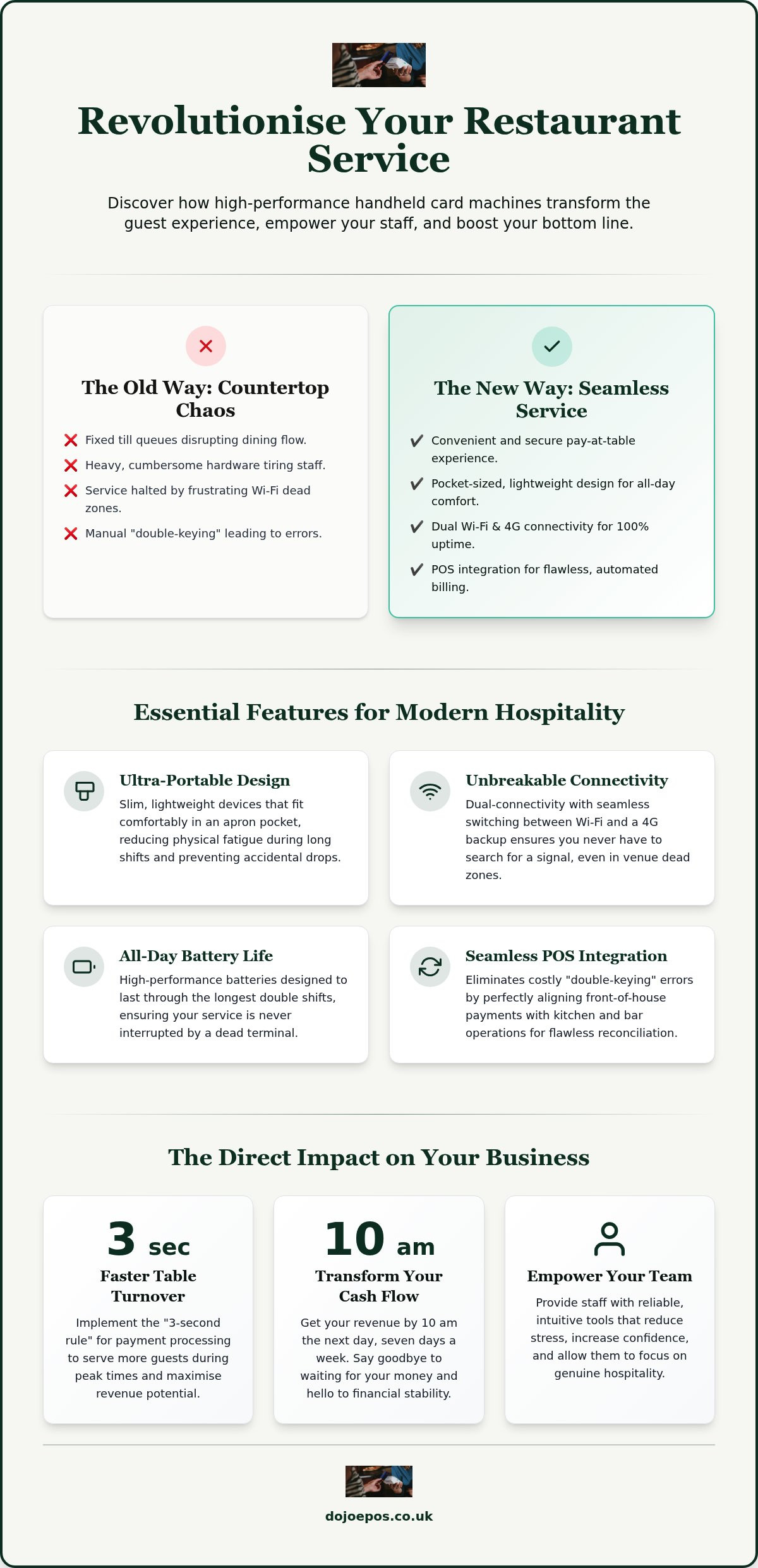
Waiters are your most valuable assets on the floor. Using a dedicated handheld card machine for waiters allows your team to focus on guest needs rather than fighting with technical hurdles. Modern devices like the Dojo Pocket are designed with a slim profile to fit comfortably in a standard apron or pocket. This ergonomic focus provides several key advantages:
Reduced physical fatigue: Lightweight tools prevent the strain caused by carrying bulky traditional terminals throughout a double shift.
Hardware longevity: Refined grip designs and compact sizes reduce the risk of accidental drops or damaged hardware.
Increased confidence: Reliable technology empowers staff to handle complex bill splits and high-pressure payments without hesitation.
When your team has tools that work as hard as they do, they can manage more tables with greater precision and less stress. High-performance hardware acts as a silent partner, working behind the scenes to make the waiter's life easier and the guest's experience more memorable.
Key Features to Look for in a Waiter-Friendly Payment Terminal
Selecting a handheld card machine for waiters involves more than just checking for a wireless signal. In a high-pressure hospitality environment, the difference between a portable device and a truly handheld one is felt in every gram carried over an eight-hour shift. Every gram matters. A device that feels lightweight at the start of a lunch service can feel like a brick by the end of a Saturday night double shift. High-performance hardware should be slim enough to slip into an apron without hindering movement, yet powerful enough to process transactions in seconds.
Reliability is the foundation of your operation. As contactless technology continues to transform the UK hospitality landscape, guests expect instant results. This means your hardware must support NFC, Apple Pay, and Google Pay as standard. Beyond the tap, the device needs a battery that survives the rigours of a full double shift. There is nothing more disruptive to service than a terminal dying mid-payment during a peak period. You need a tool that stays active from the first coffee of the morning until the final bill at midnight.
Connectivity: WiFi, 4G, and Seamless Switching
WiFi alone is a risk for large restaurants or venues with thick walls. Dead zones can lead to awkward moments where a waiter has to wander around the room searching for a signal while a guest waits to pay. A professional terminal must offer dual-connectivity with 4G backup. If your WiFi drops, the machine should switch to a mobile network instantly and invisibly. Roaming SIMs are particularly vital for venues with outdoor terraces or beer gardens, ensuring that the payment process remains secure and encrypted regardless of where the guest is seated.
Durability and Ergonomics
Hospitality is a tough environment for electronics. Your handheld card machine for waiters must be built to withstand the occasional spill or the inevitable drop on a hard floor. Screen brightness is another critical factor; it needs to be readable under the dim lights of a cocktail bar and the bright sun of a terrace. Finally, the "pocket test" is essential. If a device is too bulky to fit comfortably in a pocket, it will likely be left on a counter, which defeats the purpose of table-side service. For maximum efficiency, consider integrated payment solutions that combine this durable hardware with software that talks directly to your till system.
The Power of Integrated POS: Connecting Waiters to the Kitchen
Integration is the bridge between your front-of-house staff and your back-office operations. When you equip your team with an integrated handheld card machine for waiters, you're removing the wall between the payment terminal and the point of sale (POS) system. In a traditional, non-integrated setup, a waiter looks at the bill on the till, walks to the table, and manually types the amount into the card reader. This "double-keying" is a recipe for disaster. A simple typo can lead to mismatched totals, frustrated customers, and hours of headache for managers during the end-of-night wash-up.
With Integrated Payments, the amount is sent directly from the POS to the handheld device. It's fast, accurate, and professional. Beyond just the total, a sophisticated system like Blinq POS Software ensures that menu changes or out-of-stock items are reflected across all devices in real time. If the kitchen runs out of the daily special, your waiters know instantly. This prevents the awkward "I'll just go check with the chef" conversation and keeps the guest experience fluid. By the time the shift ends, automated reconciliation has already done the heavy lifting, saving your management team hours of manual data entry.
Reducing Human Error with Synchronisation
Syncing your devices ensures that every penny is accounted for without manual intervention. By pulling the bill directly to the handheld card machine for waiters, you eliminate the risk of human error. The waiter simply selects the table number on the screen, and the correct balance appears instantly. This speed doesn't just help with table turnover; it gives staff the confidence that they aren't making costly mistakes. Once the transaction is complete, the status of the table updates automatically on the main till, showing it as paid and ready for the next guest.
Cloud-Based Management and Reporting
The benefits of integration extend far beyond the dining room floor. Cloud-based systems allow business owners to monitor performance from anywhere, whether they're on-site or working remotely. You can track individual staff performance, identify peak sales periods, and manage permissions with a few clicks. This level of visibility makes it easier to organise rotas based on actual demand. Because everything is digital, you can sync your sales data directly with accounting software, turning what used to be a midnight chore into a streamlined, automated process that provides a truly unified view of your business health.
Maximising Table Turnover with Efficient Handheld Payments
Revenue in hospitality is a game of margins and momentum. The faster you can settle a bill, the sooner you can reset the table for the next booking. This is where the "3-second rule" becomes a competitive advantage. When a handheld card machine for waiters processes a payment in under three seconds, it removes the awkward pause that often occurs at the end of a meal. Fast processing ensures that the guest's final interaction with your brand is as smooth as their first drink, encouraging them to depart promptly and happily.
The Hidden Cost of Latency
Many operators overlook the cumulative impact of slow technology. A 30-second delay caused by a lagging terminal or a weak signal might seem minor in isolation. However, if you have 20 tables and each experiences this delay during a busy Friday night, you lose significant operational capacity. Over a full year, these micro-delays can add up to over 60 hours of lost service time. Instant connectivity ensures every square foot of your venue generates maximum revenue by keeping the guest flow moving. Eliminating the "waiting for signal" moment preserves the atmosphere and prevents the dining room from feeling like a waiting room.
Simplifying Complex Transactions
Complex transactions are the traditional killers of table turnover. Whether it's a group of ten wanting to split the bill by item or a guest who needs to add a specific gratuity, these moments often force waiters to retreat to a central till. Modern handheld card machines solve this by handling the entire process at the table side. Staff can manage split payments, take deposits, or process pre-authorisations without ever leaving the guest's side. This doesn't just save steps; it keeps the waiter present and available for other guests.
Digital receipts further accelerate this final interaction. By sending receipts via email or SMS, you remove the need for a built-in printer, allowing for a slimmer device and a faster exit. This modern approach matches the expectations of a tech-savvy audience and streamlines your internal administration. To see how these tools can transform your floor, explore our high-performance payment solutions and start reclaiming your lost minutes today.
Why the Dojo Pocket is the Ultimate Choice for Hospitality
Choosing a handheld card machine for waiters often feels like a compromise between portability and power. The Dojo Pocket changes that dynamic by delivering a smartphone-sized terminal that packs the features of a full-scale till system. It represents a shift towards a more agile front-of-house operation where technology supports the waiter rather than dictating their movements. This is hardware your team will actually want to use, designed specifically to fit into the modern hospitality environment without the bulk of traditional units.
Compact Design, Heavyweight Performance
With its sleek, intuitive interface, the Dojo Pocket feels familiar from the first tap. It removes the learning curve for new staff, allowing them to focus on guest interactions immediately. Every device comes with a built-in 4G SIM that works out of the box, ensuring you aren't reliant on patchy WiFi in the far corners of your dining room. This connectivity is crucial for a smooth "order and pay" workflow, where speed and reliability are the only metrics that matter. The device integrates seamlessly with Blinq POS Software and other leading EPOS systems, ensuring that table data remains accurate across your entire venue.
Your hard-earned revenue shouldn't sit in a bank's holding account for days. We provide next-day transfers as standard, meaning your takings are in your account by 10am the following morning, seven days a week. This includes weekends and bank holidays, giving you the consistent cash flow needed to pay suppliers and manage your business with total confidence. It is a level of financial agility that matches the physical agility of your staff on the floor.
Reliability You Can Bank On
Hospitality doesn't stop, and neither should your payments. We maintain a 99.9% uptime record, backed by robust security standards that protect every transaction. If you do encounter a hurdle, our UK-based support team understands the unique pressure of a Friday night rush. They are ready to help when you need them most, providing expert guidance that respects the urgency of your service. Switching to a better service is simpler than you might think; we help you move away from your current provider with no hidden exit fees to slow you down.
Upgrade your restaurant service with the Dojo Pocket today and experience the difference that dedicated hospitality technology makes to your bottom line. By equipping your team with a high-performance handheld card machine for waiters, you are investing in the future of your guest experience and the long-term growth of your business.
Future-Proof Your Hospitality Service
Elevating your guest experience starts with removing the friction from their final interaction. Adopting a high-performance handheld card machine for waiters isn't just a technical upgrade; it's a strategic investment in your restaurant's growth. We've explored how pocket-sized designs and seamless POS integrations eliminate the bottlenecks that slow down service and frustrate your staff. These tools empower your team to focus on hospitality while the technology handles the rest.
With integrated payments across 600+ EPOS systems and a 4.8/5 rating on Trustpilot, Dojo is a dedicated partner for modern businesses. You can secure your cash flow with next-day transfers that arrive by 10am, seven days a week. It's time to trade outdated, heavy hardware for a solution built for the speed of modern commerce. Discover the Dojo Pocket for your restaurant and take the first step towards faster table turnover and happier guests. Your floor deserves technology that works as hard as your team does.
Frequently Asked Questions
What is the difference between a portable and a handheld card machine?
Portable terminals are wireless but often too large for a pocket. A true handheld card machine for waiters is designed for ergonomic, one-handed use. It fits comfortably in an apron, allowing staff to move freely across the floor. While portable units might still require a base station or have bulky printers, handheld versions like the Dojo Pocket prioritise a slim, smartphone-like profile for maximum mobility and ease of use during a busy shift.
Can handheld card machines for waiters work without a WiFi connection?
Yes, they do. Professional devices feature dual-connectivity, meaning they use both WiFi and 4G. If your venue has WiFi dead zones or the router fails, the machine switches to a mobile network instantly. This is vital for venues with outdoor terraces or basement bars where a signal can be unreliable. It ensures you never lose a sale due to a dropped connection during a busy service period.
How long does the battery typically last on a waiter’s card machine?
A waiter’s terminal must be reliable enough to last through a busy double shift. Most high-performance devices are engineered to handle hundreds of transactions on a single charge, typically offering around 10 to 12 hours of active use. This longevity prevents the frustration of a device dying mid-service, ensuring your team can focus on guest needs from the morning coffee rush until the final bill is settled at the end of the night.
Do handheld card machines integrate with my existing restaurant POS?
Yes, and this integration is a game-changer for efficiency. When your handheld card machine for waiters is integrated with a system like Blinq POS, it pulls the bill total directly to the screen. This removes the need for staff to manually type in amounts, which eliminates "double-keying" errors and ensures your end-of-day reconciliation is always accurate. It creates a unified, professional workflow for your entire team and reduces administrative stress.
Is it possible to split bills and add tips on a handheld device?
Yes, modern terminals handle complex transactions with ease. Waiters can split bills by amount or by specific items directly at the table side, which significantly speeds up service for large groups. Guests can also add tips and gratuities on the touchscreen in a few taps. This keeps your staff present in the dining room rather than forcing them to return to a stationary till to make adjustments or process separate payments.
How secure are handheld card machines for taking customer payments?
Handheld terminals are built with robust security standards to protect your business and your customers. They utilise point-to-point encryption (P2PE) to ensure that sensitive card data is never stored on the device or your network. These machines are also fully compliant with PCI DSS regulations. You can take payments with total confidence, knowing that every transaction is secure against potential fraud or data breaches during the payment process.
Can I get my money the next day with a handheld card machine?
You can. While many providers take days to process payments, Dojo provides next-day transfers as standard. This means the money you earn today is in your bank account by 10am tomorrow, seven days a week. This includes weekends and bank holidays, giving you the consistent cash flow needed to pay staff and suppliers without delay. It is a level of financial speed that matches the high-performance nature of your service.
Do I need to print a paper receipt with a modern handheld terminal?
You don't. Modern handheld terminals are moving away from built-in printers to maintain their slim, pocket-sized design. Instead of a paper slip, you can offer guests digital receipts sent directly to their email or via SMS. This approach is more sustainable, reduces the cost of till rolls, and matches the expectations of tech-savvy diners who prefer a digital record of their spending rather than a physical receipt.


Comments